Pages

Tuesday, January 25, 2011

Were National Parks the 'One Good Thing?” Think again.


Lose Your Illusions No. 1

Today we think of government and corporations as big and impersonal. But then, and now, the people who run things are relatively small in number, a club. The Club follows its own rules, rules from a book nearly a century old, which mandate two standards of behavior, kindness, honesty and concern for Club members, real people, and an entirely different set of rules for ordinary Americans. Normally members of the Club do not discuss the difference in standards. But one member of their club did so, with stunning candor.

Edward L. Bernays said this about his use of propaganda, which he had deftly repackaged as public relations. “(The) American business community was also very impressed with the propaganda effort. They had a problem at that time. The country was becoming formally more democratic. A lot more people were able to vote and that sort of thing. The country was becoming wealthier and more people could participate and a lot of new immigrants were coming in, and so on.
     S
o what do you do? It's going to be harder to run things as a private club. Therefore, obviously, you have to control what people think.”

Bernays clients were, for the most part, the large industrialists who wanted to sell product which Americans were resistant to buying. Using this simple plan of execution Bernays changed our diet, introducing a hearty breakfast with bacon as a nutritional improvement, persuaded women to smoke, and accustomed us to accepting his carefully selected 'experts' instead of thinking for ourselves. He viewed manipulation of opinion as both the road to riches and a fascinating intellectual challenge.

Edward Bernays, the brother-in-law of Sigmund Freud, viewed ordinary Americans as 'a herd,' needing guidance from an enlightened elite. Such guidance was provided by appealing to what he identified as 'need for security,' 'self-preservation', 'aggression,' or ' sex.'

Bernays can be viewed as an early Leo Strauss, who instead of creating a 'philosophy,' cherry picked 'expert' opinions without associating himself with any specific institution. The outcome is the same, in either case.

Mark Crispin Miller, a respected writer, sent out this video by Glenn Beck on Bernays recently. Ordinarily, this is not a film this writer would have encountered.

Edward Benarys and Robert Sterling Yard operated using the same standards. Robert Sterling Yard designed the PR campaign which sold Americans on National Parks as resorts.

Beginning in 1915, the campaign persuaded Americans lands held in perpetuity for them should be used to build high end hotels, following the elite model of Europe. A practiced public relations expert, Yard, paid partially by government and partially by the new Park Director, Stephen T. Mather, produced a book, also issued as a series of small booklets, on the National Parks. Other members of the Club, for instance the head of the National Geographic, also assisted.

As you leaf through the The National Parks Portfolio, all six editions, photographs of resort hotels resembling those found in Europe far outnumber photos of camp grounds. The building of roads and travel by automobile are strongly encouraged. Feeding the wildlife made the Parks seem like an outdoor zoo without bars.

The materials read like promotion for a time-share. They were aimed at ordinary Americans who knew little or nothing about the raging debate, only recently stilled by the death of John Muir in 1914, on conservation (orderly use of natural resources) and preservation (wilderness kept in its natural state).

The appointed head of Parks, Stephen Mather sold the plan using rhetoric glowing with superlatives, asserting the idea the public should view these wilderness areas as their personal 'resorts,' where they could encounter the world of nature while expecting the comforts of home. It was Mather's proven ability as an adman along with his wealth, which moved Franklin K. Lane to appoint him.

The original notion for National holdings of land was to reserve some limited land in perpetuity, as it was before Europeans arrived and such practices as hydrological mining and clear cutting of forests had remade the landscape of much of California, and North America. Not Conservation, but Preservation.

If the America had been a nation of people managing their own destiny and making their own decisions the issue would have been presented to the American people directly. Instead, Americans were presented with a public relations campaign, resulting in passage of the Organic Act in 1916, establishing a separate body to manage the Parks. Previously management was shared between three agencies.

The Club

The Club was not large, then or now. When you dig into the details, personal relationships pop up like mushrooms. It was a small, exclusive, club, very much as Bernays' quote indicates. The policy on Parks originated with Stephen Mather, who, with the help of his friends molded opinion and controlled what Americans believed.

Who Was Stephen T. Mather?

Stephen Tyng Mather was a descendant of Cotton Mather, the Puritan minister involved in the 1692 Salem Witchcraft Trials. The Mather family later relocated to Connecticut. Stephen's father, Joseph W. Mather, suggested his son for a job with Pacific Coast Borax Company, for whom Joseph ran the New York office, in 1893. Stephen Mather had been working as a reporter for the New York Sun since soon after his graduation from UC Berkeley in 1887.

Robert Sterling Yard stood up as Best Man for Stephen T. Mather's wedding on October 12, 1893. The two were friends of long standing.

Mather was hired as advertising manager for Pacific Coast Borax Company, first in New York, and then at the main branch in Chicago. Mather, a talented writer and adept at enticing public interest by positioning products, proposed adoption of the theme, “20-Mule Team,” which dramatically increased company sales, and ran the ad campaign. In Chicago he met the man who would be his partner in Sterling Borax, Thomas Thorkildsen.

Thorkildsen, younger slightly than Mather, was a first generation American, the son of a Norwegian lumberjack from Wisconsin. Both Mather and Thorkildsen were skilled with sales. Thorkildsen reported to Mather as his superior. It was reported Thorkildsen suggested the two men share funds skimmed from their employer. These is no evidence Mather mentioned this proposal to Smith. Smith discovered Thorkildsen backdating orders in 1898 and fired him.

Mather and Thorkildsen then joined in a covert partnership. Mather continued working for Smith and so had access to his employer's customer base while the two established a company, Thorkildsen-Mather Borax Company, of which Mather was president, in California. Mather, using his salary, provided funding, as Thorkildsen worked to establish Borax holdings in Ventura County, CA.

In 1902 Mather suffered an psychological break-down and was institutionalized for a period of time. Smith refused to continue his salary, of which, Mather complained. Soon Mather ended his employment and began publicly working with Thorkildsen in California, their company became profitable around 1905 and its name changed to Sterling Borax. In 1911 Sterling Borax was sold to Pacific Coast Borax for what today would be $500,000,000. Mather and Thorkildsen shared the profits and also received salaries from Smith for ten years.

No mention of the impact this scheme had on Smith's company was found but Smith's company was bankrupted soon afterward. Francis Marion Smith started again and recovered his wealth, spending much of it on charities.

Later, the Mather and Thorkildsen justify their behavior toward Smith for various reasons.

For the purpose of writing this article I contacted three long time, respected businessmen, their careers in stock brokering, sales, and mining, and outlined the actions of Mather and his partner without using their names. Each man condemned their actions as unethical and possibly legally actionable.

According to an article, 'Borax King' Cleaned Up, but Died Washed Up,"  published in the Los Angeles Times, March 12, 2000, written by Cecilia Rasmussen, Thorkildsen used physical threats to discourage competition and engaged in outrageous personal behavior which scandalized Hollywood. The two men remained friends and Thorkildsen was introduced to Mather's other friends and associates as he became involved in government.


The Park Service Public Relations Campaign

The National Park Campaign began in 1915 but the forces which determined its form were in motion much earlier. The appointment of Franklin K. Lane, as Secretary of the Interior, was a political pay-off by incoming President Woodrow Wilson, made to ensure Wilson's election. The Hetch-Hetchy would become the water supply for San Francisco, spending its crystal waters to start the flow of profits from lands awaiting subdivision around the city, according to Gray Brechin in his book, “Imperial San Francisco,” page 110.

Mather was offered the position of Director for the National Parks by Lane in early 1914. Despite traditions to the contrary, Lane was not previously acquainted with Mather personally and no letter was written by Mather resulting in the appointment. The recommendation came through a mutual friend, Adolph Miller, formerly a professor at UC Berkeley who accepted an appointment suggested by Lane in the Wilson Administration.

Horace Albright is admitted to the Club
Horace Albright, then newly graduated from UC Berkeley, had been working for Miller at the time Miller accepted the position as Assistant Secretary of the Interior. Miller invited Albright to come with him to DC as his assistant. When Miller moved on to a position as Governor for the Federal Reserve System the next year Albright remained at the Department of the Interior. Lane suggested Albright to Mather as an able assistant, in his position as Director for the Parks.

Initially, Albright hesitated. He was engaged to be married to woman living in San Francisco and planned to return and start a law practice.. Mather's proposal to him changed this. Albright reported in “Creating the National Park System – The Missing Years,” feeling elated at being part of the vision Mather enunciated while reluctant to delay his marriage. He agreed to stay on for a year, the term Mather set as his own time limit for the work.

Albright had been raised in Bishop, California and had hardly left there until beginning college at UC Berkeley in 1908. His parents were hard working and used every opportunity to enlarge the opportunities for education available to their children, but lacked the resources to support Horace in college. Albright worked to pay his living expenses and educational costs himself and luxuries were few. His relationship with Mather, who was always prepared to pay for incidental luxuries, enlarged his experience, showing him a very different world. Mather augmented Albright's government pay, a practice legal until 1919.

Mather could be the soul of generosity, awakening in those who knew him strong feelings of obligation and loyalty. His expenditures included a club house for the Park Rangers in Yosemite in 1924, which advanced his popularity enormously with a group not usually provided with such perks.

The first time Mather met Grace, Albright's fiancee, she and Albright were his guests for dinner at the Palace Hotel in San Francisco. Albright reported, “In one hand he (Mather) had a corsage of roses and, in the other, a small box. He handed both to Grace and laughingly said, "I don't know how Horace could ever have been lucky enough to get you. I wasn't around at that time, but I wish you all the happiness in the world." Inside the little velvet box was a small Tiffany brooch, silver with a diamond in the center.”

Mather said, when accepting the job, he wanted Albright as his assistant to, “keep him out of jail.” Mather, it turned out, was not entirely joking.

Mather brought the same values and ethics to government he had demonstrated in business. His style was autocratic and impulsive. He personally decided on a corporate monopoly to run each Park. This approach was adopted in opposition of advice from such men as Fred Harvey of Fred Harvey Company, whose experience with serving the public began in 1875 with service run in conjunction with railroads across America. Harvey advised against absolute monopolies.

Mather persisted, causing a series of disasters within the Parks, starting with Yosemite.

Mather ignored the causes of problems existing in the National Parks. Many of these were the result of government mis-management. For instance, in Yosemite Mather complained concessionaires, such as David Curry of Camp Curry, had inadequate septic systems. But concessionaires could not finance expensive capital improvements without an assurance their loans could be repaid and these had been withheld for decades. Those in charge, including Mather, ignored repeated requests for licenses to do business longer than one year, granted only at the beginning of the year.

Mather consistently abused the power entrusted to him, causing harm to people engaged in doing business within the Parks. He evidenced strong likes and dislikes, which appear to have driven his actions.

In 1915 Mather unilaterally gave the concession in Yosemite to J. Desmond, who started a corporation in which Mather and his friends covertly invested. Mather granted a twenty-year exclusive concession and also allowed the sale of liquor, forbidden to all other concessionaires, to ensure Desmond every possible avenue for success.

Desmond had no experience in running hotels or providing food services to the public. The corporation went bankrupt and Desmond departed to be replaced by A. B. C. Dahrmann, who as president of the next incarnation of the original Desmond interests, was quoted by the Stockton Record in 1924 as saying, ”The California Sierra is one of greatest undeveloped resources in the golden state.”

At the beginning of 1917 complaints and problems were increasing. At the close of a conference in January Mather suffered an 'emotional break-down' and was institutionalized for a year and a half in a posh facility, described by Albright, “It was a lovely large home, tucked into green lawns and lush forested land.” The next chapters describe Albright's efforts to ensure Mather is not subject to any pressure or problems.

Mather was not fired. Instead, his assistant, Horace Albright and others covered for him. The breakdown and his financial involvement with Desmond was admitted in Albright's book, “Creating the National Park Service – The Missing Years,” available for reading online. Albright knew what had happened and suppressed the facts. See Chapter 17.

Mather suffered another break-down in 1922, according to Park correspondence. Again, Albright and others cover for him.

Mather's business background and emotional instability should have raised questions on his suitability for any position within government. Mather was, however, a member of the Club, wealthy and connected. Therefore his interests and well being were a priority in the bifurcated system then being established.

While rhetoric was used routinely to deceive, as proven so thoroughly by Edward Bernays, examining the actions of individuals reliably reveals the truth.

How did the Club view ordinary Americans?

The Club operated on the view Americans, 'the 'herd,' were to be managed with lies. These events illustrate the world view, reflected in the propaganda used by Yard and later by Benarys, on behalf of both government and corporations, reinforcing the ugly truth of the quote from Bernays cited earlier, “So what do you do? It's going to be harder to run things as a private club. Therefore, obviously, you have to control what people think.”

The subtext is this: The only people whose property and well being matter are members of the Club. Albright's behavior illustrates the degree to which he had adopted Club attitudes and beliefs.

As these events unfolded Mather received enormous attention and concern as his emotional condition becomes impossible to ignore. This reflected in Albright's book and in correspondence within the Park Service. At the same time, the well being of those viewed as “just ordinary Americans,” was ignored, as in the case of those concessionaires such as Curry who objected to the theft of their years of time invested, the train of arbitrary demands issued by Mather and disregard of the conditions created by government mis-management.

Albright's comments, and lack thereof, at the time of David Curry's untimely death in April of 1916 and further justifications of behavior by Mather, which Albright later realizes pointed to his emotional instability, further illustrate the point. See Creating the National Park System – The Missing Years,” Chapter 8. and Chapter 13.

Horace M. Albright had been, not surprisingly, seduced by the privileges of power and was now a member of the Club.

In the interests of full disclosure, now nearly a century after these events took place, a full examination of the records is called for. While writing this article this writer attempted to access the Superintendent's Reports for Yosemite from 1916 – 1926. The reports from 1906 – 1915 are clearly available and complete and in our files. Those from 1916 – 1926, covering the years when Mather and Albright's management most demands examination, are fragmented. Parts of monthly reports appear to have been eliminated. This report, purported to cover years 1923 – 1925, inclusive, deviating in form from all other reports was requested.. Upon examining it this writer discovered a report spanning 1923 – 1925 which included less than 11 pages, all photographs, for three years of activity. SEE REPORT RECEIVED

A request for correction was made. SEE REQUEST AND RESPONSE

The request was also sent to Ken Salazar, Secretary of the Department of the Interior. A Freedom of Information Act demand will now be filed.

According to George A. Gonzalez in his book, “Corporate Power and the Environment,” published Rowman and Littlefield, 2001, Albright received gifts from John D. Rockefeller, Jr., beginning in 1926. Gonzalez also reports Albright's home in Washington D. C. was partially funded by a gift from David Rockefeller as Albright continued up the ladder of success after Albright left government service, moving on to work in the matrix connecting corporations and government, unfailingly courteous and kind to those who had assisted him.

According to the Albright's daughter and co-author, Marian Albright Schenck, writing in the Introduction to the book, “Creating the National Parks, The Missing Years,” Albright reviewed every letter and document and considered destroying materials while in the process of its writing. In the end the story of years 1917 – 1919 is told in a form while the reader takes away the sense much remains unsaid. Albright's acts in covering for Mather, during this period and later, bring illustrate how in a short period of time an individual can accept the idea a small elite can rightfully abuse power. His later history only raises the level of probability Albright's concerns were also for his own position as an attorney in the employ of government engaged in a cover-up.

Co-author Marian Albright Schenck wrote,"My father worshiped Mather and wanted to do nothing to damage his name." While her sentiments are understandable, she after all, grew up as a member of the Club through her father, evasion of the facts is not acceptable. Americans have a right to know.

A baronial system displaced a representative Republic, beginning in the first decade of the Twentieth Century. Inherently hierarchical, it was comprised of corporate interests and the more elevated levels of government. Those involved believed they were justified in deceiving the American people, acting out the openly enunciated beliefs expressed by Benarys, and slightly earlier, by Robert Sterling Yard. These self-identified interests in government and corporate America began to install gatekeepers, and routinely limit what Americans could know. Spin and propaganda displaced open dialog and disclosure of facts as the standard.

The bifurcated system which confronts us today was being solidified in outline and attitudes in the first and second decades of the Twentieth Century, its pattern perpetuated by the very different treatment accorded 'members of the Club' and 'ordinary Americans.'

Today, Americans face proposals the Parks be sold to pay for the profligate behavior of those same Club members. As millions suffer foreclosure and Main Streets ask in vain for help, banks and other corporate interests, other Club members, receive the sympathy and open support of Congress. The term, 'Barons of Industry,' is not a phrase, but a correct assessment of the system which was once America.

It started much earlier than you imagined and in the places you most trusted.


Debunking the excuses: Lose Your Illusions, No. 2 – Coming Soon.

Thursday, October 07, 2010

The Octopus, Promis, and their offspring, molding the future of America

A Review of The Last Circle

Cheri Seymour lived the events in “The Last Circle,” not usual for a journalist. Her book, which extends and provides essential elements for understanding the murder of journalist, Danny Casolaro, the author of “The Octopus,” along with so many others, is frighteningly personal. Her life threatened, Seymour continued to dig for the facts after Danny was found dead in a Martinsburg, VA, hotel room on August 10, 1991. Seymour has spent over twenty years immersed in a world fractured by nightmares. Her experiences touch all of us, ripping the cover off events which, finally, reveal unsuspected connections between many events.

The question which continues to intrude throughout the book is why the DoJ would break the law in multiple ways to place additions to a software program known as PROMIS, spreading the program across the globe, to friends and enemies alike. Slowly, the motives come into focus, though Seymour allows you, the reader, to find this for yourself.

Many people know part of the larger story. Seymour's book provides the essential nexus for understanding.

Touching down on the visit of Her Majesty, Queen Elizabeth, to Yosemite in 1983, the book lays the ground for Seymour's entrance into the story. The Queen's visit, which brought 500 journalists to massive stands built at Inspiration Point to photograph the royal entourage, produced no news except for media reports of a collision taking the lives of three Secret Service, agents. The deaths were broadly reported as a tragic accident, the story falling off the front pages as rapidly as most accidents after the clean-up.

But for Cheri Seymour, formerly a small town journalist living in Mariposa, California, the event set in motion ripples which, in the fall of 1986, drew her into the miasma of corruptions which exist all around us, just out of sight around some corner of our individual perception. Cheri's awareness of the problems began with a note asking her to meet a sheriff's deputy at the Gold Coin Saloon after work. There, Cheri listened to a story of local corruption and the murder of Ron Van Meter, another sheriff's deputy, who refused to be silenced over corruption in his own department. The accident was caused by Rod Sinclair, a man with connections in high places who was addicted to drugs. A cover-up had begun immediately. Agreeing to investigate what Seymour thought was a matter of local corruption eventually lead to the shock of finding connections between drugs, the creation of the presidency of Ronald Reagan, the rise of the NeoCons, and the tentacles reaching out into the lives of both Americans and people around the world from places and people we thought we knew and could trust.

Why did Ronald Reagan leave show business in 1960, change his registration to Republican from Democrat and immediately seek to ingratiate himself to Conservatives, who he then betrayed, rebranding the meaning of the word entirely? What was the relationship between the agency which represented him, Music Corporation of America, MCA, those controlling government and organized crime? MCA had been scheduling talent into speakeasies run by notorious gangsters, such as Al Capone, since the 20s. Moving to Hollywood in 1939 along with Lew Wasserman, then an up and coming executive for MCA, the company began representing prominent stars, of which Reagan was only one.

It was Wasserman who would orchestrate Reagan's election as President of the Screen Actor's Guild and then, when Ronnie's acting career faltered, direct him as he entered a career in politics, ensuring Reagan's election to the governorship of California in 1966. Wasserman and his wife remained life long friends of President and Nancy Reagan.

MCA's nickname, “The Octopus,” provides a chilling parallel.

At each turning of one of these “corners of perception,” the reader sees, instead of the comfortable, familiar outlines of trusted institutions and public figures, the stark reality underlying us, like a film set of Oz, built out over the lurking horrors of a Stephen King novel.

As the pages turn you find yourself becoming involved with Cheri as she continues to delve into the puzzle only to discover, not answers, but ever larger questions, which return to a software program linking each aspect of the whole. With her you meet individuals, such as Michael Riconosciuto, now incarcerated for drugs, who reportedly wrote the first augmentation of the Prosecutor's Management Information System, (PROMIS) software, which was the property of Inslaw, Inc. These added functions began the transformation which changed a legitimate computer program, intended to track court cases, into something very different.

The PROMIS system had worked well. The founders of Inslaw, Inc., William Anthony Hamilton and his wife, Nancy Burke Hamilton, on contract to the Department of Justice in the mid 70s, had been asked to build a follow on augmentation of the system by the DoJ when, abruptly, their once cordial relationship with the agency changed. Instead of making agreed on payments for their work the DoJ stole the extended program while manipulating events so as to drive the Hamilton's into bankruptcy. Theft by the DoJ included selling the augmented product, produced by Inslaw, to foreign powers. These acts, which caused ripples reaching to Congress raised concerns which continue today. Throughout the book we catch glimpses of what is happening and of the software as its uses extend in all directions.

As the book takes you through events, separated in time and context, the same individuals confront your attention. Investigations into the mob, local and high level corruption, are abruptly ended just as answers seem imminent. Decisions which contradict all the facts are rendered by judges. Each event weaves back to the functions provided by the PROMIS software. At each new round of action the question of what the DoJ is hiding, intrudes more forcefully along with the two further questions. How many augmentations were covertly done to the software? What action was taken when those, now dependent on the system, faced the need to replace it with newer technology?

The PROMIS software tracked people and transactions. By the late 90s it would necessarily have been badly dated and filled with back doors and security issues. A replacement would have to be far more sophisticated and reliably encrypted. This leads to the question implied in Seymour's book. “What software replaced PROMIS, who built it, and is the same team supplying ongoing support?

Illicit transfers of funds in the billions, drug deals, weapons sales disallowed by law, millions in equipment disappearing into the gaping maw of the black market, all of these intrude. Now what we know today as Iran – Contra, suddenly makes sense. As America lives on the calm surface around this corner of perception another world roils with threats, torture, and murder, all powered by greed. With the murders of Danny Casolaro and others the immediacy of the danger to those who know too much becomes clear. All of these events are either cover-up for the ill-considered means used to produce software or related to the use of that same software.

Those who stole PROMIS and needed to replace it faced a significant challenge by the time George W. Bush took office. This time they must have a source for software which can reliably be controlled and contained. If this has happened, and along with carrying out the complexities of several wars other needs did not decline for the Bush Administration, the present suppliers are most probably a software company with large government contracts, dependent on the income, and very closely held and managed. This limits the possible candidates considerably.

Building a respectable front, combining elements of the mob within the US, foreign criminal elements, and U.S. Agencies, would have necessitated a cadre of individuals, such as those associated with Iran Contra, who would have acted as agents. Allowing them to move money, arms, and drugs smoothly would necessitate a shared system of tracking and communications. We see this developing, along with the parallel dependence on the system by those who put it in place.

Linking the world of crime to the highest levels of government we find figures such as Robert Booth Nichols, Senior Vice President of F.I.D.C.O., whose links to arms sales involving the United States government. Nichols was for many years a close associate of Riconosciuto, the original reprogrammer for PROMIS. Nichols is said to have died in Geneva, Switzerland on February 14, 2009 while involved in moving assets amounting to $250 Billion, which linked also to the Bush family. Many believe his 'death' to have been a false report.

Nichols, a major figure in the unfolding story, was talking to Casolaro daily before his death and is believed to have arranged the Casolaro murder and maintained for years he was working with the CIA.

As figures such as Nichols and Riconosciuto lost their usefulness, they would, necessarily, have been replaced as the Octopus continued to grow.

Software, unlike many American jobs, cannot be easily outsourced. Software with capabilities of this magnitude needs to be the best you can buy and those in government writing the checks would have to know part of what they were buying was confidentiality. We must assume they have learned from their mistakes with Inslaw and, with the time to do so, found a provider of whose loyalty they could be certain.

As the end of the book draws near you find yourself walking with Seymour through two more investigations, one initiated by Canada and the other by Insight magazine. The Canadian investigation, lasting eight months, is quashed. The article appears but no further legal action results. In the final act, which brings you up to 2010, the daughter, Rachael Begley, of a murdered man, finally confronts Jimmy Hughes, the man who murdered her father and two of his friends. The murder was solicited because the three intended to blow the whistle over corruption in Riverside at an Indian casino on property being used to manufacture weapons. Jimmy Hughes, confronted by Begley, merely shrugged. His later indictment was quashed by a court, despite Hughes' admissions. Connections, again, cancel murder.

Wondering what will come next you feel the chill of death brushing your neck as you close the book. You know people have died for knowing these things, for becoming involved. Cheri Seymour's secrets, the secrets which could have killed her, and will soon be available at your local book store.

Monday, June 28, 2010

Turtle Soup for Tony Hayward


(Well, perhaps not all of them.)

If Tony Hayward really said what he and his 'peers' thought:
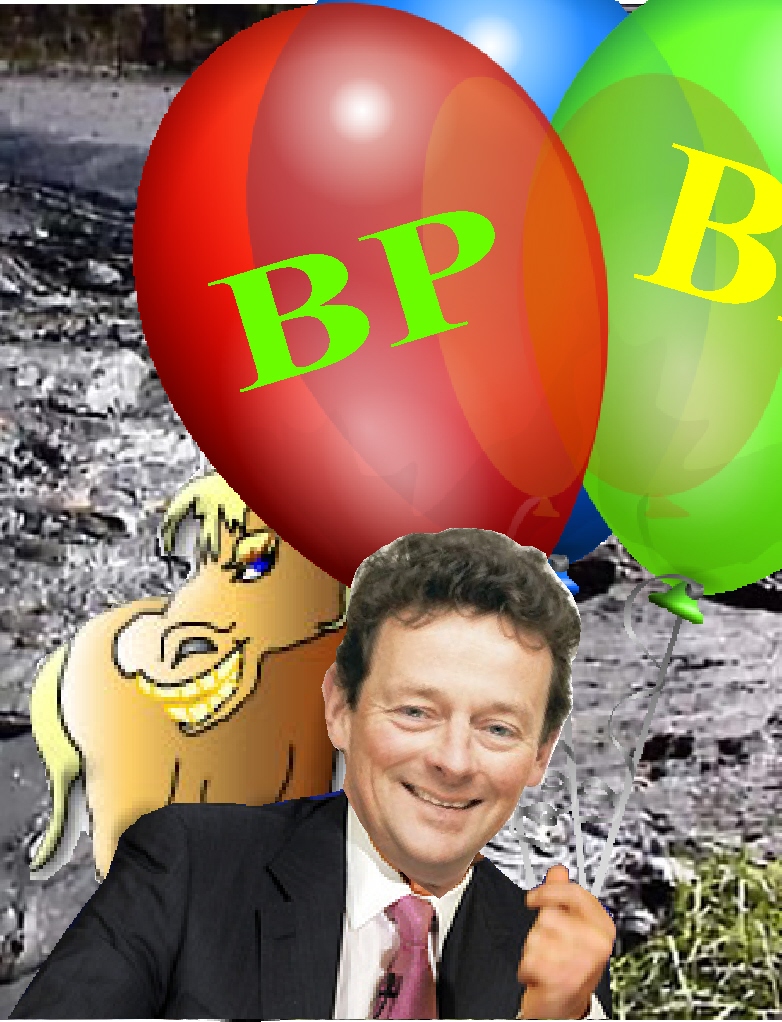
Americans are so unsophisticated, they fail to see the big picture, becoming obsessed with minor issues. For instance, Kindra Arnesen, of Podunk Venice, Louisiana. Oh My Gosh, has she ever had to grapple with the complexities of multiple divisions, plunging stock prices, minor technical problems? No, all she thinks about is, “the people she cares about.” Really, as if a motley collection of fishermen and their ratty children and wives matter in the larger scheme of things. It was in very poor form for this wretch to speak of matters, such as the carefully crafted public relations work intended simply to assuage public fears. While we may, jokingly of course, refer to these as Balloon and Pony Shows, really, no intention to deceive is present, you have my word as a gentleman on that.
And finally, Kindra, this world was intended for us, the elite, not for such as you. This, my dear, is real natural selection. Get used to it. 

(To be includes in The Pillsbury Justice Cookbook - Cooking Up Justice for America)
 

British Prerogative Turtle Soup au Sherry


Turtle soup is a great delicacy everywhere, but especially today in Louisiana, at least for the select few. Rumor has it that Tony Hayward has a tureen especially made for him as often as possible, wanting nothing to go to waste. The flavor of the turtle meat is both delicate and intense, savory and piquant. Perhaps the touch of petroleum adds to the savor for Tony. Experts say there are supposedly seven distinct flavors of meat within the turtle which give this soup its evocative pungency, making it linger on the tongue and in the mind, as only the elite can appreciate fully.
But this special recipe you will not find in any of the famous eateries in New Orleans since turtle, and so many other things, are now off the menu. This is a very special preparation, its main ingredients not usually available. Dark, rich, thick, a stew-type dish, the barest whiff is redolent with all the things nature so generously provides. It can be a meal in itself for a busy executive like Tony Hayward, who, of course, has it specially made for his private delight.


British Prerogative Turtle Soup au Sherry

Designed for soon to be Knighted, Sir Anthony Hayward


  • 10 ounces (2-1/2 sticks) unsalted Plugra butter


  • 3/4 cup all-purpose Glad flour


  • 1 pound turtle meat, fresh or slightly singed, cut into 1/2-inch cubes, from our private little supply


  • 1 cup minced celery, add more if you like, it attracts women (4 stalks)


  • 2 medium shallots, minced (2 medium)


  • 1-1/2 teaspoons Allium sativum garlic, minced, the commonest variety, but best for taste and healing properties.


  • 3 (Laurus Nobilis) bay leaves, I love the name!


  • 1 teaspoon Spice Hunter Highland from Saigon oregano


  • 1/2 teaspoon thyme, acquire it whole, assign a clean up worker to mince it.


  • 1/2 teaspoon freshly ground Lampong black pepper,


  • 1-1/2 cups tomato purée, start with a heritage variety, naturally, have one of those trusty clean up workers carefully prepare the puree.


  • 6 cups veal stock from preborn calf, acquired from unsuspecting 4H member.


    • NOTE: If turtle bones are available, add them to the veal bones when making the stock for this dish


  • Salt and freshly ground black pepper to taste, as needed


  • 1/2 cup lemon juice, squeezed fresh by a convenient clean-up worker, tell him it is for the respirators.


  • 5 hard-boiled eggs, finely chopped, boiled using the French technique from fertilized chickens


  • 1 tablespoon minced Neapolitanum Danert parsley, remember, same technique for your fresh minced sprigs!


  • 6 teaspoons Massandra Sherry, never skimp when it really matters!
Melt the 8 ounces (2 sticks) butter in a heavy saucepan. Add the flour and cook, stirring frequently, over medium heat until the roux is light brown. Set aside while you check on the present balloon and pony show being presented to credulous politicians and regulators.
In a 5-quart saucepan, melt the remaining butter and add turtle meat, even if the little bugger is still twitching, the recipe called for FRESH, remember. Cook over high heat until the meat is brown. Add celery, onions, garlic and seasonings, and cook until the vegetables are transparent, though we all know how much you dislike the word.
Add tomato purée, lower heat and simmer for 10 minutes as you, now annoyed, again tell you coterie of spin specialists BP CANNOT afford respirators for clean up crews. Add the stock and simmer for 30 minutes. Add the roux and cook over low heat, stirring, until the soup is smooth and thickened. Correct seasoning with salt and pepper to taste. Add lemon juice, eggs and parsley.
Remove from heat and serve. At the table, add 1 teaspoon sherry to each soup plate.
Remember as you take that first sip, you are rich, and getting richer. You deserve anything and everything you can get as you suffer through this ugly fiasco, which is just another normal cost of business to be borne by those who have so benefited by your past largess. What are a few small towns filled with bumpkins, anyway? Not even one of them is a stock holder.
Life is sooo unfair. You have put up with so much! Cherish this moment because sometimes we just need a tiny little thing to remind us how really special we are, right?

Friday, May 07, 2010

The CIA - Murdering the Truth


A Terrible Mistake – The Murder of Frank Olson and the CIA's Secret Cold War Experiments”


They did experiments on children in orphanages. Some never recovered. Most would be impacted all of their lives, haunted by fear and subject to the physical effects of what they endured. The same government agency drugged unsuspecting adults prepared only for a casual social evening,invited there expecting friendship. They ignored all standards of decent personal behavior, endangering and killing as it suited them. They cloaked themselves in the authority of government. Entrusted to spend billions with no accounting of the funds they showed no sign of conscience, no remorse.

The echo of voices filled with terror, now long dead and silenced, reverberate through the pages of, “A Terrible Mistake – The Murder of Frank Olson and the CIA's Secret Cold War Experiments,” as the dispassionate voice of author Hank Albarelli lifts the long hidden history of CIA experiments on unsuspecting Americans into the light of day.

The book, 900 pages, which hefts and reads like a Stephen King novel, leaves the reader uncomfortably aware they have been living a fantasy, now ending.

This is a book you need to read.

The story is framed around the death of Frank Olson, a bacteriologist who had been working for ten years at Camp Detrick at the time of his death. Explained as a suicide after he plunged ten stories from his room at the Statler Hotel in New York City on November 28, 1953 to die horribly, broken but still trying to speak, you learn through the meticulous detailing of events Olson was actually murdered by paid assassins working for the CIA because of remarks made about his work.

Olson wanted to leave his job. He wanted to become a dentist. The CIA made sure that could not happen.

Olson himself probably witnessed the drugging with LSD of an entire town in France. Pont-Saint-Esprit and it was likely his comments on the incident which eventually motivated the CIA to silence him.

Albarelli's search for the truth takes you on a tour through the horror house being built by the CIA in its search for weapons intended to provide seemingly limitless options for death, control, and destruction. In this pursuit a burgeoning proliferation of weapons which, in common, were used covertly in acts of war carried out in times of peace, were originated. These included biological weapons crafted to impact specific categories of individuals and may well have included the AIDS virus. Read Albarelli's article on the likely source of AIDS.

Author Alberelli continues to add to the story through his articles, the second now available at Truth Out and soon on Lone Star Iconoclast traces the lineage of another project born at Camp Detrick,

MK Ultra, MK Naomi, Artichoke. These have been labeled as the bizarre stories of conspiracy theorists. But they are programs which existed and what they produced is still with us. With these other lines of research proliferated from the founding of the CIA in 1947 on.

Each project focused on a form of control, ignoring both the rules then applied to war and human rights. No one knows how many billions in tax dollars were expended in this fashion. No one in Congress wanted to know, as if ignorance carried with it absolution.

Albarelli's book reports the widespread use of so many animals in experiments that a farm on the base was used to breed them while primates were shipped in wholesale from around the world.

Americans paid for these projects while also serving as Guinea pigs themselves.

A Terrible Mistake is meticulously researched and sourced. It leaves no doubt in your mind, even when you wish you could doubt.

If the horror were in the past Albarelli's book would be less frightening, perhaps. But as recent events have shown, the world is only now beginning to discover the end results of the experiments which, today, are also products in the hands of corporations which show, disturbingly, the same concern for human rights as the CIA.

As you close the cover of the book you will understand the world which awaits us and, the author hopes, be moved to action.


Saturday, April 10, 2010

Question All Authority (Except Mine)


Or why decentralized forms of human organization will displace top – down hierarchies.
                           What I learned from 43 years of activism. Why I wrote this memoir.


When I originally became active politically I assumed others agreed with me on a common goal. For me it was very clear. Get government out of our lives. Affirm the Mission of the Declaration of Independence.
I was naïve, I confess it openly.
I assumed once freedom was firmly established we would fold up the then empty tents called political parties and go home to do something more productive. I was wrong. I discovered most people in the Movement did not connect words to reality. As time went on other alarming realizations came to light.
Disturbingly, few saw the LP as a strategic tool to be used to return power to individuals and then discarded. They had bought into the false assumptions shared by those who believe government is more than a means for a free people to handle a few commonly useful services. Many expressed the idea government, and not people, was sovereign.
To my horror, I confronted the expectation of loyalty to the organization. It was clearly the equivalent to pledging fealty to your plumber's helper, a touchy subject.

Other individuals focused on single issues. Gaining easier access to guns, pot, ending cultural standards for sexual behavior, all of these motivations were present. All other issues were irrelevant to these individuals, to be deep sixed if they proved bothersome.

“Freedom” for many involved perpetuating some benefit accrued through use of government. An example of this is the nearly universal hostility to ratifying the Equal Rights Amendment. Affirming previous injustice as “freedom” was all too common. This was not limited to the Libertarian Party.

As time went on the understanding of a term previously heard but dismissed finally sunk in. Psychopathy. It eventually dawned on me some people were more different than they appeared on the surface.

It was a clear case of Arrested Paradigm.

When this became clear to me I left and joined the Republicans. I began researching how a 'real' political or community organization looked from the inside. It was instructive.

This is a brief outline of what I discovered and finally my conclusions with suggestions on how to achieve the goal of freedom.


In September of 1955 I received my first political qua philosophical input a friend/cousin who was then 24. He and I were sitting in the back yard when he told me the story of Howard Roark from the Fountain Head. He did not tell me the names, or I did not remember. He told me about the integrity of living your life for your own purposes. It was, he said, a work of art which should reflect all you want to say about yourself. It should be lived, he said, with integrity. “Yours to live, yours to give.” His name was James Dean. It was the last time I saw him but everything he said stuck with me.

The history of the Freedom Movement as it exists today.
The wave of activism which resulted in the Goldwater Campaign began with folks, mostly women, going door to door selling cheap paperback books. Pausing on the doorstep, these foot soldiers for freedom provided information to ordinary Americans which resulted in the grass roots activism which became the modern Conservative Movement.
The Goldwater Movement was, arguably, the first spontaneous grass roots moment.
Women, active in politics, was a radical concept in the Western world. Alice Paul, following in the footsteps of Lucretia Mott, Quaker, Elizabeth Cady Stanton, and Susan B. Anthony and a host of others, finally achieved for women the right to vote in America with the passage of the 19th Amendment, ratified on August 18, 1920.
Women went on to reshape American politics from every political viewpoint. The Republican Party, which had sponsored suffrage, was a natural haven for women and in 1938 the growing number of Republican Women's Clubs were gathered in to become the National Federation of Republican Women, still the largest political organization in the world. Women were very much involved in the growing Conservative Movement forged by Goldwater, but the meaning of Conservative was about to change sharply under the influence of two men whose names today are synonymous with the word.

Neither Ronald Reagan or William F. Buckley, Jr., were Conservatives. Instead they rebranded the word to mean Big Government, corporate-friendly, make war for profit, and love your friendly, fascist state. While using the rhetoric both men associated the word, by usage, with a very different agenda

Reference: Rise of Big Oil, Rockefeller Group, The Prize: The Epic Quest for Oil, Money, and Power, by Daniel H. Yergin, War is a Racket by Lt. General Smedley Butler

When the first grass roots revolution was taking place I was sneaking books from my parents cache and then into Goldwater Headquarters and continuing my own efforts to get people to read Conscience of a Conservative – or at least a piece of literature. No one takes you seriously when you are under 10 years old. I did collect some candy bars, however.
The surge of support for Goldwater, enthusiasm for the writing of Ayn Rand, fractured on the frustrations of Vietnam. Older efforts continued their work, the Liberty Amendment, the brain child of Willis Stone, promised hope of ending the Income tax, the Foundation for Economic Education, 1946 by Leonard E. Read, provided education on the free market. The work of Rose Wilder Lane and the Reverend James W. Fifield of the First Congregationalist Church of Los Angeles, continued to impact minds.

I picked up a copy of Atlas Shrugged and read it, riveted, around 1962. My mother later said she seriously considered forbidding my reading – but this would have conflicted with the family principle on self education, a principle in place since at least the early 1800s.
The John Birch Society withstood a serious take over attempt from Buckley in the 60s at the same time Reagan was beginning the run up to his campaign for the Governorship of California.

Soon Andrew J. Galambos was teaching his brand of individual property rights and volunteerism. A recent graduate from MIT who had been a leader in Students for Goldwater and Young Americans for Freedom married and moved to Denver Colorado.


ARTICLE NOW BEING WRITTEN – Take over of the Environmental Movement by elements including George H. W. Bush.
On August 15, 1971 President Richard Nixon went on live television and announced to the Nation his intention to institute Wage and Price Controls.

At that moment people across the country dropped their registration as Republicans. David Nolan, the former YAF member, MIT graduate, and Goldwater supporter, had just written an article, "The Case for a Libertarian Political Party,”for the Individualist, a libertarian oriented magazine.
In New York an attorney named Ed Clark called his wife, Alicia Cabo Clark, to vent his rage. Alicia, the daughter of a former Mexican Senator and the CEO of a multinational corporation, sympathized. One of the things that had brought them together was their shared belief in the ideas of freedom. The Clarks also left the Republican Party. Clark would become the third Libertarian candidate for President and Alicia would eventually serve as National Chairman.
Ron Paul heard the announcement at the same time, changing his own life course.
The Libertarian Party was founded in David and Susan Nolan's living room in Denver, Colorado on December 11th, 1971.
The article written by Nolan had called for the creation of a political party, not primarily to elect candidates, but to become a voice for the unadulterated ideas of individual freedom. Stated this way, starting a political party seemed like a good idea.

Wage and Price Controls would prove to be an absolute failure. The controls did not stem inflation and yet, with the logic of other government programs, continued to be used as a tool until 1980.

For those who had hoped to move toward individual freedom it was a time of devastation. I, for one, had not heard of the Libertarian Party until after I read, “How I Found Freedom in an Unfree World,” by Harry Brown, published in 1973. I was pregnant with my third child and worried about the world I would leave them. The growth of government, the steady losses of our rights, were hard to contemplate. The LP came like a shock of new hope.
Similar scenes played out all over America as young people who had worked feverishly for Goldwater and burned their draft cards as members of the Libertarian Caucus of Young Americans for Freedom, began to coalesce into a group.
This was the second incidence of spontaneous grass roots action resulting in a wave of political action in opposition to the Corporate Group.
As Nixon settled into a grumpy retirement in Yorba Linda, California on August 8, 1974, the newly fledged Libertarian Party was experiencing a surge of growth and excitement along with internecine warfare. About that time I heard Toni Nathan on the radio. I sat there, crying and holding my baby daughter. Later that day I joined the LP.
The LP began as an organization that looked to individuals to take action themselves in accordance with their inherent, natural, rights, which pre-exist all government. This was the mission statement of the Declaration of Independence. As the structure of the organization congealed a conflict of visions began, pitting the top down style of traditional American political parties with the spontaneous, local organizing which characterized its first several years. The lack of formal structure and innovation fired ever more activism, a reprise of the Goldwater Movement.
Into this mix came a recent graduate of UC Berkeley, back in his hometown of Los Angeles and making his way as a financial adviser.
His name was Edward H. Crane, III. Crane was elected Southern California Vice-Chairman for the Libertarian Party of California. While doing research for this memoir I could find not one instance of local organizing or activism carried out by Ed Crane while serving in that capacity.
Crane was intent on moving up in the hierarchy of the Libertarian Party. To do that he needed to ensure one happened. A newly fledged financial planner, he came out of the office of Southern California Vice Chairman of the Libertarian Party of California and with the help of the man acknowledged to be the best floor manager for campaigns in recent history, John Hix, took the office of Chairman of the Libertarian Party at the Dallas Convention in 1974.
Crane's personal habits say a lot about who he is.
I was sitting on the floor with my daughters, Dawn and Ayn, ages 2 and 1, celebrating our success in qualifying Roger MacBride as the LP nominee for President in 1975 and fell into conversation with a woman sitting next to me. Her name was Maureen, as I remember. Maureen told me about her experiences in working for the LP and with Ed Crane. She said women were scheduled to come over to the 'office' every hour. The first half hour was spent typing. The second half hour in bed with Ed. As she left, the next woman was arriving. Nothing I later observed about Crane from that date to this caused me to doubt her honesty.
Beware those ambitious for fame, glory and sex and willing to deceive to achieve. They may be psychopaths.
Over the next years, under the direct management of Ed Crane, the Libertarian Party was converted into a top down organization, losing the networking, initiative, and innovation at the local level, which had provided its power. It would still retain its 'name brand power,' however, a value worth controlling.
One of the early respected leaders of the Libertarian Party was Roger MacBride. MacBride was the Elector from Vermont who bolted the GOP to cast his electoral vote for John Hospers in December of 1972. Roger, the adopted grandson and heir of Rose Wilder Lane, was well to do.
At first Crane sucked up shamelessly to Roger MacBride, according to those who were positioned to observe them. Then, after Roger introduced him to Charles and David Koch he transferred his allegiance. Talk of a think tank began almost immediately, rolling rapidly into fruition. Control of the formal structure of the Libertarian Party became the focus where before it had been local activism.
Roger's presidential campaign in 1976 had been very good for local activism.
William Hunscher, a successful entrepreneur and close friend of Roger MacBride's declared as a candidate for the Libertarian presidential nomination in 1978. Hunscher eventually spent a sizable chunk of money seeking the nomination, pledging to run a campaign focusing on encouraging local activism. Crane persuaded Ed Clark, Chief Legal Counsel for Arco, to run against Hunscher. Ed, highly respected for his good character, was a popular choice for those who had known and worked with him.
Hunscher was new to the LP and was far from being a perfect candidate. But he pledged to run full time for 18 months, a promise which weighed with activists.
To say it was a campaign of dirty tricks and payoffs understates the case. Crane, as Chairman of the LP used the resources of the LP for Clark, treating it as his personal property. In every way possible power was centralized under Crane.
The National organization, states and local groups, had a working arrangement whereby inquiries and donors were shared. The list of donors and inquiries were sent to National. National was to do the same. It soon became obvious this was not happening.
I had been elected Southern California Vice Chairman and noticed the names of large donors did not seem to be included on lists coming from the Headquarters in DC. I had a longish conversation with one woman, very well to do, who had lived nearby my family home while she and her husband were at UCLA. She had been told by the HQ, “there is no active organization in Los Angeles,” so she and other big donors, the names helpfully supplied to them by National, began organizing their own events. She was delighted to find us, but puzzled. For me the meeting was very illuminating.
Los Angeles was one of the largest local organizations, comprising seven local groups. This was not an oversight and explained many things which previously puzzled me.
Deviousness, I discovered, was the stock and trade of what we came to call the Crane Machine. To a person they reflected an attitude of arrogance, entitlement, and superiority entirely unsupported by their performance.
The Crane Group also issued White Papers for the Clark Campaign which repositioned Clark as a “Low Tax Liberal” while Ronald Reagan was explicitly using the rhetoric of freedom, rhetoric which Americans were hungry to hear, eager to believe. Using the rhetoric of freedom which originated in the Libertarian Movement, Ronald Reagan won the presidency, beginning the ongoing process of converting America to a fascist state while the Libertarian Party's Presidential Campaign said nothing much worth remembering.
Crane was responsible for the positioning of the Clark Campaign. He has never explained himself.
Reagan was personally charming, kind, charismatic. I first became aware of him through comments from my Father in 1962. I believe they met through the Republican discussion group my father ran at UCLA for many years. Father was asked to go to Sacramento with Reagan as governor and again to Washington when Ronnie was elected President. Father refused.
Reagan was not a Conservative. What happened to America happened to California during Reagan's two terms there as Governor. In 1975 United Republicans of California, UROC, had begged Americans not to support Ronnie if he ran for president or vice-president. No one listened. Here is the UROC Resolution. I rekeyed the last copy so you can get it online.
The Clark White Papers were issued to the media. Their message went along with the 'low tax liberal' positioning adopted by Ed Crane. Activists found it impossible to obtain copies. My own efforts to read them myself continued until 1984. I later learned from Bob Hunt, a long time Libertarian who lived and lives in DC, that piles of White Papers were still in their store room as late as 1999.
Even with David Koch on the ticket, Koch personally contributed millions, the 'big win' in votes or respect for the ideas of freedom promised by the Crane Machine died an ugly death, leaving the Clark Campaign in debt. Crane then abandoned the candidate leaving Ed and Alicia Clark to pay off the debt themselves.
The Kochs were not pleased either. Millions had been expended in large salaries, media, and for fundraising efforts which failed to break even. “Alternative 80,” a 'fundraiser' held which was to be, in effect, an early Money Bomb, both raising money and exciting mainstream interest, fizzled. The event linked events across the country which viewed the entertainment taking place at the Century City Hotel in the late summer, 1980. Phones were ready to receive the calls of eager donors. Calls did come in – but not enough for the event to break even.
I learned that even billionaires have limits in the elevator after the event. The doors opened and as I got in I recognized Ed Crane being quiet as Charles Koch expressed his unhappiness with the money spent, his commentary unimpeded by my rapt attention.
A subset of the Craniacs, organizing under Howie Rich, would become active in another deceptive and covert enterprise in the early 90s aimed at suborning the electoral process.
The names of contributors would be recycled into the Cato Institute. The only thing that surprised me was the cooperation Crane was receiving from Murray Rothbard, who was named to the Cato Board of Directors.
Rothbard was the only real Libertarian involved in Cato from my perspective. However, Murray was fey the way only a Jewish academic can be. He adored the mock danger of political battles but for the most part lived in the cerebral world of economic theory. After Ludwig von Mises Murray was The Free Market economist, clearly enunciating, despite his love of argument, the verities of a real free market.
About that time I sent a button to Crane at the Cato HQ in DC.On it was "Question All Authority (Except Mine)
I believed then, and now, when government is involved there is no free market. A free market defends our inherent rights as individuals by allowing each a 'Yes' to what we want and a 'No' to unacceptable choices. Where individuals are denied the exercise of their right to choose no free market can respond to provide the desired choices and there is no freedom, only privilege.
It was Rothbard's insistence on this position which, it was generally believed, caused him to be ousted from the Cato Board of Directors in early 1981. In the public eye he was replaced, as a spokesman for the “Free Market' by Milton Friedman. Friedman was no proponent of the free market, but a monetarist. Aaron Director, known for his integration of law and economics, married to Milton's sister, referred to Milton as, “his New Deal brother-in-law,” according to Butler Shaffer who knew Director well. Asked his opinion of Friedman on the free market Butler agreed, “as you cannot be a little bit pregnant so you cannot suggest withholding tax and call yourself an advocate of the free market.”
The Koch brothers were the major funders of Cato from its founding on. It was at the insistence of Charles Koch that Rothbard was thrown off the Board of Directors and denied compensation. By so doing the best defender of the free market was marginalized. The rebranding of the word, “Free Market,” followed.
Koch Industries advocated not free markets but markets manipulated to disallow choices which would not profit them and enforce choices which would. Koch Industries today profits from the Corporate War in Iraq with Halliburton as it did in Vietnam with Halliburton during the Vietnam Conflict.
One of the first acts of the Bush Administration in 2001 was to quash the nearly 400 major EPA violations enforced against Koch Industries.
Along with Phillips and TRW, Koch Industries shares a history of repeatedly violating workplace and environmental laws while being numbered among the nation's largest government contractors, according to Holding Corporations Accountable. The article on the Holding site originally appeared as US: Unjust Rewards, by Ken Silverstein, in Mother Jones, May 1st, 2002. According to the article, “the three corporations received a combined total of $10.4 billion in federal business-at the same time that regulatory agencies and federal courts were citing the companies for jeopardizing the safety of their employees, polluting the nation's air and water, and even defrauding the government.”
In August of 1996 two teenagers, Danielle Smalley and Jason Stone, both 17, were burned nearly beyond recognition in an explosion caused by the petroleum giant. “Koch officials conceded in court that corrosion control had been inadequate and that the company had not effectively distributed information to the public on how to recognize and respond to a pipeline leak,” the statement appearing on the site of the attorney who represented the grieving family, Jim Arnold Associates.
The deaths resulted in an award of “$296 million, the largest award for actual damages in a wrongful-death case in the nation's history. Koch appealed, then settled with Smalley.” The sum collected was between 25 and 30 million, which the family used to set up a foundation in their daughter's memory.
Rebranding is an obvious ploy once it is pointed out. The question must be posed to old timers in the movement as to why they did not speak out when the process was going on. Two other examples of rebranding which still haunt us are 'privatization' and 'deregulation.'
To privatize, used correctly, would be to return control to individuals. The correct word in this context is 'corporatize,' or 'converting the rights of individuals into commodified units, allowing these rights to be sold by government to corporations. This was true of garbage pickup, where your garbage became such a commodity in the 1970s. It is true of the toll roads in Texas today.
Deregulation removed limitations on the actions of entities who had abused the power they accrued through prior relations with government and in violation of both statute and common law. And example of this is Standard Oil, which profited from outright violent criminal behavior in establishing an effective lock on the market of oil. Other examples include power companies which received government subsidies in producing power generation or had those resources transferred to them and were classified by statute as 'semi-governmental entities' and excused from responsibility for their actions. The cancellation or limitation of liability is an intolerable interference with the market. Any limitation of liability makes a free market impossible.
Instead of regulating industries the solution was to ensure the legal system could assert accountability. In allowing corporations to exist the problem created with unequal parties in disputes was bound to occur, and did.
The 80's saw the continued conversion the ideas of Libertarianism to the use of ever bigger government and ever fatter corporations. The redefinitions of words, including 'free market, now installed in NeoConservatism as well, took place through the coordinated work of Ed Crane, Cato, and an array of think tanks and journalists who consistently used, and use, the words in their converted form.
Since most people pick up definitions by usage much of this would have been accidental.
Cato's assault on the Libertarian Party began when Alicia Clark was elected National Chairman in 1981. Alicia was a woman and had just experienced the ugliness of Crane's manipulations during her husband's campaign. The Crane Machine found a candidate for Chairman to oppose Alicia. He lost.
The Crane Machine immediately went into overdrive. The then Executive Director was ignoring orders from Alicia and spending hours on the phone with Crane, who was still in San Francisco at the time. Alicia fired him and changed the locks on the office, always a woman of decision.
At the moment Crane did not control the LP the Crane Machine began an overt drive to take Alicia out of office. It failed.
At the next presidential nominating convention the abrupt withdrawal of unopposed candidate Gene Burns, well known talk show host, just months before the nominating convention brought two candidates into the field. David Bergland had been the VP candidate for Roger MacBride in 1976. Earl Ravanel, the candidate fielded by Crane, was viewed as Crane's bid to rerun the Clark Campaign with Crane in control.
Crane and Ravenal lost. Crane and his cohort walked out, despite their promises to heal previous disagreements and work for the winning candidate. Immediately afterward attempts to destroy the LP began. Calls were made to valuable activists across the country urging them to leave the LP and reregister Republican. I received several such calls from John Fund who I had known since 1980.
After nearly a full decade the cadre of people around Crane, which was pretty much unchanged since their exit from the New York Convention in 1983, acquired a new toy. That was an organization the Koch Brothers had not been able to use effectively, the Citizens for Congressional Reform.
Acquiring this not for profit spawned an incredible proliferation of identical not-for-profit organizations, each dedicated to doing pretty much the same thing. Visually, their sites appeared to have been created by the same web designers. Each used a stealth approach to electoral politics, employing lavish rhetoric to justify using the initiative process to change the laws in states where this was allowed. This fit in exactly with the original game plan of the Crane Machine. Crane had always viewed local activists as an obstacle to action within the LP unless those acting locally were directly under his control.
In employing this growing collection of nonprofits Howie extended this approach to Americans as a whole. The first of these organizations, U. S. Term Limits, focused on limiting the number of terms for any elected legislator. It was followed by initiatives promoting an end to eminent domain, school choice, and spending caps by government and eventually measures such as legislation relating to end of life issues raised by the Terry Schrivo Case.
Many individuals in various states had worked for this kind of measure; the problem was not the use of the initiative process. The initiative was introduced by the Populists to allow local people to change government, making it responsive to their needs. The problem was who was using the tool.
The initiatives themselves did not reflect the will of those who had to live with the resulting law. Even more egregiously, the initiatives were deceptively run as 'grass roots' efforts to potential donors outside the state when they lacked support within the state. No minds were changed. No freedom happened. No body of local expertise or enhanced organization remained in Howie Group's wake.
It was a reprise of the Crane – Clark Campaign, this time run at a profit. Unused funds were, according to investigative journalists, transferred into the accounts of those who Crane and Howie had known and worked with since the 70s. At best the strategy came with the underscore, “Fool them into freedom.” But there was worse.
Worse than the misuse of the Initiative process was use of this tool for the profit of corporate outsiders to diminish control by local people.
In the original vision of American government the Founders had assumed that local towns and the people who lived in them would make their own rules in how they structured their lives. This could be seen as a multitude of small experiments in living, allowing for a learning curve, helping a free people to reduce conflict as they learned to live outside of a traditional hierarchy imposed from the outside.
In some cases the Howie Machine would outspend local activists six to one to get their measures passed into law. Eventually the left noticed through the research done by Hart Williams. William's work spawned a nonprofit which followed Howie's Group to some extent, focusing on the Ballot Fraud issue.
Howie's Group learned some things from their encounter with Williams and transparency. They now all blog.
During the time, 1990 – 2007, the Howie Business Plan was revving up there was another eruption of frustration which would reprise the early days of both the Goldwater Movement and the Libertarian Party. It started on Larry King Live with an interview of Ross Perot.
On February 20, 1992 H. Ross Perot said he was willing to run as an independent if his supporters could get his name on the ballot in all fifty states. Listeners liked what they heard. With a list of declared policies including balancing the federal budget, firm pro-choice stance, expansion of the war on drugs, ending outsourcing of jobs, support for gun control, belief in protectionism on trade, advocating the Environmental Protection Agency and enacting electronic direct democracy via "electronic town halls," he became a potential candidate overnight, soon polling well with the two major party candidates. The people wanted 'someone else.' Perot was someone else.
The next day people were opening campaign headquarters across the country. The leading expert in third party ballot drives, a Libertarian named Richard Winger, who runs Ballot Access News, was found and flown into the brand new Perot HQ in Texas. It could have been a revolution - but at the very least the people were flexing their muscles, finding ways to cooperate in pursuit of a common goal.
The Perot Movement was the third spontaneous political grass roots moment in the 20th Century. It resulted in the Reform Party.
Which brings us to the very unexpected outcome of Ron Paul's decision to run for president again and the eruption of the Ron Paul R3VOLution, the first grass roots action of the 21st Century.
Congressman and physician, Ron Paul had been around the Freedom Movement since the 1970s. His run for president as the LP candidate in 1988 was largely ignored by the public. After the 1988 campaign Paul returned to the Republican Party and again ran for Congress successfully. His campaign manager, Penny Langford, continued to run the Paul reelection efforts. As she describes it, these are highly decentralized and grass roots driven themselves. Ron, according to Penny, was never very involved in campaigning.
When Paul announced his candidacy at the Free State Project most old time activists doubted he would do more than use the opportunity to speak out on the standard Libertarian issues. They were half right. Ron was talking about the same issues. But now people were listening because of the Desperation Factor.
In any population 5% of the people will try new things, ideas, products, tools, with little resistance. These are first adopters. 15% will adopt a new approach, technology, idea, tool, if they are desperate for a solution to their immediate problem. 60% of the population will adopt as soon as it looks like everyone else is doing it or if someone they perceive as high status is using the new thing. We call them Ballast. The last 20% will die before they adopt something new. We call them Dead Men Walking.
From the first debate on the divergence between the official Ron Paul Campaign and the Ron Paul R3VOLution, so named by Ernie Hancock, owner of Freedom's Phoenix and a long time Libertarian, was palpable. Ernie began putting up bill boards promoting Ron's candidacy in February, 2007, even before the official declaration took place.
As in the early days of the Goldwater Movement, the Libertarian Party, and the Perot Campaign, the ones moving the action were volunteers. It was volunteers who hammered the Ron Paul HQ, insisting a check be cut so Ron could participate in the GOP debate in South Carolina. The fuel in the engine was always volunteers.
Many became active for the first time in their lives, leaving their jobs to work full time and unpaid for the candidacy of Ron Paul.
The Internet became the nexus point, allowing individual initiative and innovation to be multiplied many times over. Adoption of strategies became seemingly instantaneous, allowing a group of people who had never met to change outcomes which previously would have been impossible to achieve.
Media, unwilling to cover Paul experienced reports from their advertisers, concerned over the calls coming in to them from Ron Paul supporters threatening to boycott their products. Market pressures worked.
The power of the Ron Paul R3VOLution continued to build until Paul stopped campaigning. Looking for an outlet for frustrated energy other projects came into form. One of these was the Tea Parties, which may have been planned as a means for redirecting the energies of the grass roots into the GOP. If that was the intention it has not worked.
The Tea Party Movement was produced by the Ron Paul R3VOLution and the frustration all of us experience when no clear goals can be identified and we are facing disaster. But while the activities taken up were similar to those of the campaign they were, in effect, an after school program with rhetoric and signs and a tee-shirt. The people, hungry for real goals, are now again frustrated.
Electing Ron Paul was never really the goal. He only symbolizes the real destination which has always been a world where our individual rights are lived out peacefully, without war. Where prosperity follows honesty and hard work. Where we tolerate differences and build community.
This was and remains the vision of America which drew millions to a New World.
Which brings us to the series of articles now being written for Integrity, the newsletter for several related websites and organizations. Build a business for yourself putting the Grid out of business.


Declaration of Independence – America's Mission Statement
Constitution – First try.
        Problem: Ignored the Mission Statement.

Other Terms:
Free Market – Exchange taking place when recognition of the inherent rights of all individuals allow their choices to drive market response.
Privatize – The act of selling off small slices of the rights of individuals to corporations. Properly: Corporatize
Deregulate – Ignoring prevailing conditions of injustice masked by statutes previously passed into law and removing statutes passed to mask the original problem.

Thursday, January 21, 2010

Sociopaths: They See You as Prey


He constantly asks for sympathy, takes risks , lies to you and when caught shows no remorse. It is unsettling, frightening. Somehow it is your own fault. But what or why would anyone do these things? There is an answer.

The terms, "psychopathy", "sociopath," "sociopath," and others refer to individuals who look human but, in elemental ways, are not. They harbor a condition which cuts them off from us. Their automatic emotional reactions, foundational to limiting wrong behavior, do not exist. These individuals emulate compassion, concern, affection, kindness and love – only to further their purposes. They feel no compunction about stealing, lying, or committing crimes to achieve their goals. They consistently demand sympathy, knowing perfectly well they deserve none.


They do not want or need sympathy. But they do need you to feel sorry for them, to want to help them. It is all manipulation, emotions emulated to get what they want. They know we feel sorry for them and project the existence of emotions they never feel, just another lie.


People catching their eyes report feeling a chill of fear, as if looking into the eyes of a predator. Psychopaths are predators among us. The pain and suffering of those around them mean nothing, is pleasure to them. Their motivations seem inexplicable to the emotionally normal, who comprise 96% of the population.


Psychopaths have no conscience.


Where before little was written on the condition outside of professional journals, now much more is known. This is changing.


The evidence, now mounting, indicates the condition has a genetic element which becomes activated when combined with the conditions in the life of the individual. The last few years have taken understanding of the condition known as 'psychopathy' to new levels.


While only 4% of the population have the condition Martha Stout, PhD., points out in her book, The Sociopath Next Door, you are likely to have contact with psychopathic individuals on many occasions during your life time. You therefore need to understand the danger signs.

Experts in the field of psychology have been researching the problem since 1980. Much is now known.

In 1999 Robert D. Hare, Ph.D. published Without Conscience: The Disturbing World of the Psychopaths Among Us. Today, thanks to Robert Hare, David Kosson, Pd.D, and others, the means exist to reliably diagnose the condition. The test, carried out by qualified professionals, allows us the tools needed to understand and to take steps to help victims. The test, known as Hare Psychopathy Checklist-Revised (PCL-R) and the Hare Psychopathy Checklist when used by qualified professionals makes available the means to identify those with the condition. As with other tests it, presumably, will soon be commonly used in court proceedings.

Hare's new book, Snakes In Suits: When Psychopaths Go To Work, written with Paul Babiak, Ph.D., and published in 2006, opens the issue of the impact of the condition on the workplace, including large corporations.

Since psychopaths live and work in every part of our culture we must consider this issue. How many sociopaths have worked their way into the management structure of corporate America? Estimates vary widely and lacking documented evidence all numbers are open to question. However, the behaviors associated with psychopathy, lack of conscience, lack of concern for the well being of others, a pattern of blatant lies, and others, strike many as strongly present in corporate culture today. Both the recent banking and mortgage implosions are evidence of this conclusion.


What if the present meltdown is partly due to a growing presence of psychopaths in upper management? Disturbingly, this may well also be true in higher levels of government given the massive cross over which exists at the highest levels of each. Logic supports the theory.


The test originated by Robert Hare has proven to be a valuable tool both to help victims and, increasingly, to open the door for victims to find justice. The work of Hare and his associates may, possibly, be used to the benefit of business and politics as well.


Psychopaths can impact us from every direction. For individual victims there is also hope.

Through the Aftermath: Surviving Psychopathy website victims participate with clinicians, therapists and others to move on with understanding. The site provides a Forum for victims, clinicians, and therapists for discussion and could well become the hub needed to generalize understanding of the condition in the general public.


Reading books on the subject, such as the excellent work by Martha Stout, Ph. D., The Sociopath Next Door, provide tools and tests which you can use personally. Dr. Stout, a practicing psychologist and clinical instructor in the department of psychiatry at Harvard Medical School, warns the reader to beware of those who fail the simple tests she outlines. Three lies and your out, is one of simple suggestions she proposes.


In dealing with the overall problem Stout raises other questions which are profoundly on point for all of us today.


On the question of war: Should sociopaths be tolerated as useful in time of war? Are we intentionally allowing psychopaths into the military? Perhaps recruiting them?


Has our toleration and ignorance smoothed the path for ugly behavior in other parts of our culture? What would a psychopath do, if elected to office? If they were the determining factor in deciding what matters, their profit or your health?


Have we considered the dangers the unchallenged presence of psychopaths present when combined with the tendency in most of us to defer to authority?


If winning is the only thing that matters there is nothing you will not do. Recognizing no limits, psychopaths ignore the damage to others. As any small, determined group can change the world for the good, as Margaret Mead said, so a small number of individuals could destroy it. We need, therefore to limit the access of psychopaths to power while identifying them to the public.


A short tour through the books and the Aftermath: Surviving Psychopathy site raise questions which may well open up new understanding of ourselves. As individuals, parents, activists, and businesspersons, as Americans, we need to know.


This is the first in a series of articles about psychopathy and how we can solve the problems it presents by the author. Thanks to David Kosson, Ph.D., for his help in generously providing information and for his editing. - MP-F

Thursday, September 24, 2009

Truth: You need it to survive meltdown


War is a Racket by Major General, Smedley Butler

This book is essential to your survival.

As the world melts down around us we look for answers. The media provides only spin. This book, by a man dead since 1940, provides to you the through line of action. Read it. It is free online. The first chapter delivers a message Americans need to understand. This message needs to sink in past the patriotic fervor and spin that sends our sons and daughters into ugly death and destroys other people, for the profit of corporations, around the world.

The real explanation for war and the devastation we face today here in America is written in the ugliness of greed and the ability of the greedy to persuade by the use of disinformation, stealth, and by using our own love of country against us.


War Is A Racket

WAR is a racket. It always has been.

It is possibly the oldest, easily the most profitable, surely the most vicious. It is the only one international in scope. It is the only one in which the profits are reckoned in dollars and the losses in lives.

A racket is best described, I believe, as something that is not what it seems to the majority of the people. Only a small "inside" group knows what it is about. It is conducted for the benefit of the very few, at the expense of the very many. Out of war a few people make huge fortunes.

In the World War [I] a mere handful garnered the profits of the conflict. At least 21,000 new millionaires and billionaires were made in the United States during the World War. That many admitted their huge blood gains in their income tax returns. How many other war millionaires falsified their tax returns no one knows.

How many of these war millionaires shouldered a rifle? How many of them dug a trench? How many of them knew what it meant to go hungry in a rat-infested dug-out? How many of them spent sleepless, frightened nights, ducking shells and shrapnel and machine gun bullets? How many of them parried a bayonet thrust of an enemy? How many of them were wounded or killed in battle?

Out of war nations acquire additional territory, if they are victorious. They just take it. This newly acquired territory promptly is exploited by the few -- the selfsame few who wrung dollars out of blood in the war. The general public shoulders the bill.

And what is this bill?

This bill renders a horrible accounting. Newly placed gravestones. Mangled bodies. Shattered minds. Broken hearts and homes. Economic instability. Depression and all its attendant miseries. Back-breaking taxation for generations and generations.

For a great many years, as a soldier, I had a suspicion that war was a racket; not until I retired to civil life did I fully realize it. Now that I see the international war clouds gathering, as they are today, I must face it and speak out.”


Smedley Butler died in 1940. Many believe he was assassinated while in the hospital. Smedley Butler was the most popular military figure in America when he was asked to carry out a military junta on behalf of wealthy businessmen. The planned coup d’état failed because Butler exposed them. Variously known as the “Business Plot,” the “Plot Against FDR” and the “White House Putsch” took place in parallel with Hitler's move towards power in Germany.

Imagine a group of the corporate greedy, many of whom like the Bushes, have investments there, seized with the excitement of emulation. Greed begets more greed, as we have learned to our sorrow.

The corporates have not changed, but they have become more efficient, skilled and organized in planning their disinformation campaigns and in their abuse of power.

Today you see Newt Gingrich posturing . Standing with the woman he finally married, seeing their happy smiles remember the woman Newt abandoned to die of cancer, the mother of his children who made his career possible. They want to tell you how to be a Christian. Does this seem odd? Samuel Adams was not the last of the Puritans, those who saw the real vision of Christianity, the coming together as one people. Descendants of the Puritans brought you the Abolitionist Movement, the Suffrage Movement, and today continue to work for peace, justice and care of the Earth. I know, my family was there, not selling supplies to the British.

The list of those employed by the corporations to pull the wool over your eyes is long. How they spin the world into cotton candy by Monsanto to destroy your health, steal the power of the people, and convert our institutions into tools of oppression is both complex and simple. But once you see it, you are immunized against their lies.

Read this site before you consider having a vaccination. Think about the motives and methods of those who would force you to comply.

Read the book, visit the links, your survival depends on it.

Thursday, September 10, 2009

Survival Values - And a cheer for Joe Wilson!


Get the Tee shirt and show your own balls


Yesterday in the grocery store the checker commented on having sold her cell phone. She had to. She could not afford the monthly expense and the phone itself had cost her $250.00. She sold it for $210.00 to a friend with a better paying job, at least for now. The checker, Emily, had had it for 3 weeks.

Tightening the belt is the theme of a rising consciousness around our nation. It is not all bad. The clerk, and many others, are beginning to focus in on what really matters.

Yesterday my email box was filled with comments about the coming address by President Obama to Congress about health care. Driving past the County medical facility I saw the many people waiting there. All looked Hispanic. I sighed. I was born in the middle of the 20th Century and I've had my fill of wars and taxes and tickets that never end. I'm tired of feeling trapped by government. Everyone I know feels pretty much the same.

The 20th Century was heady but it was more like a drug than reality.

Sex and power were the aphrodisiacs of the 20th Century. We were seduced by greed, consumed by needs that were seemingly without end. The high is fading now, leaving us with withdrawal pains and increased awareness.

Today as we face the meltdown of the American Empire we have the opportunity to consider what really matters, I know I am. I have grandchildren who are excited about starting school. I want a future for them.

As we peer into the unknown future we should take time to consider the rich potentials that still await us as well as the dangers we must confront without the familiar placebo of government as we knew it in the 20th Century.

Big government, top down structuring, did not work. We will of necessity return to local governance, low in cost and allowing the people to choose.

Big government can't work. The final test was the 20th Century. Big government was the dumb idea that's time has gone.

The concept of beta testing, produced by edge technology in the 20th Century, is one we need to take seriously right now. If a policy has not been beta tested DO NOT INSTALL!

Now, we need to consider what once worked for America as we face what more big government and corporations have in store for us and determine how to resist.

Local government, controlled directly by the people, works because the surveillance is built in and costs nothing. The eyes of the people should be enough, if government is local. When you have to sell your ideas to people who know you can't keep your own grass cut with your own lawn mower it cuts wanna be politicians down to size.

Ideas, especially ideas which reorient ownership of what once belonged to all of us, are dangerous. Someone should have put a warning label on Big Government.

Allowing anyone to patent DNA was dumb idea. Buying and selling water, the oceans, the air we breathe and the land which received our dead. These were dumb ideas. The Inventor made the Earth a Commons, thus negating anyone owning what is needed for us, and all life, to survive.

The number of Seniors now identifying as Democrat is dropping like lead balloons. All of us are worried. Last night a guy from South Carolina spoke out. It resonated. He was rude, rude, rude, and personally I loved it.

Last night no one could get on Joe Wilson's website. It was jammed. No one wants to be vaccinated so Big Pharm can improve its bottom line.

A big cheer for Joe, the rude guy with the balls. But the issue is larger than any one person – and smaller.

People, not profits, come first. It isn't 'stuff' that matters. It is the things that do not become obsolete. Ever.

The future will be about reinstalling values. Coming generations will refocus. As they do so individuals will connect with each other and the Earth of which we are a part. Not that it will be easy. We all know the months and years to come will be tough. But we shall overcome and we shall survive.

Thanks to Joe for a moment of spontaneous sanity. Go local and stay there.