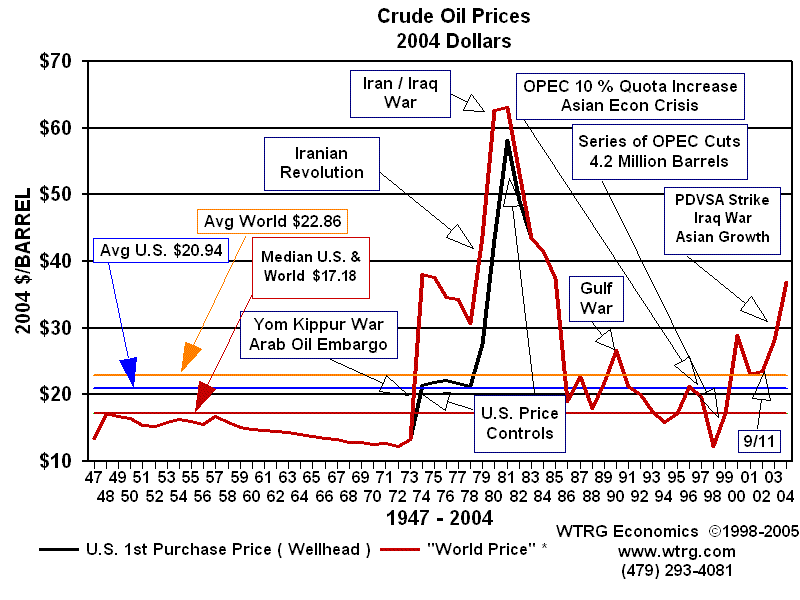
Charges against Venezuelan president, Hugo Chavez have been leveled for years. These include, “Chavez has won a loyal following among the poor through multibillion-dollar social programs including subsidized food, free university education and cash benefits for single mothers. " Shocking crimes against humanity, right? Almost up to the Abu Ghraib level. And now that nasty Chavez is talking about, gasp, nationalizing the oil leases of Exxon-Mobil. Where will this madman stop? You can almost see Bush getting out his road map and squinting down at it, tracing the route through Mexico. Wrong turn there, Georgie, that is the way to Canada. Think towards your non-extradition hide out in Paraguay.
The quote continued, "Chavez insists he is a democrat and will continue to respect private property - though he has boosted state control over the oil industry and has said he might nationalize utilities.”
As Jon Stewart and other prominent American critics point to Venezuela and the actions of Hugo Chavez, re-elected by an overwhelming majority to the office of President, accusations that Chavez is, gasp, horrors, a socialist, also abound.
Ignorance is so exasperating, especially from those who should know better. Chavez himself makes this mistake, using the dreaded“S” word. How could they all be so wrong? But wrong they are. Chavez is not a socialist, but socialists lurk all across the United States and it is time to expose them.
Let's begin by defining our terms. What is a socialist? Thanks to the Internet, this is a question easily answered.
“An "economic, social and political doctrine which expresses the struggle for the equal distribution of wealth by eliminating private property and the exploitative ruling class. In practice, such a distribution of wealth is achieved by social ownership of the means of production, exchange and diffusion." (7)
The programs provided to poor Venezuelans are funded through income generated through the Venezuela Petroleum Corporation, a corporation owned by that nation. Venezuela nationalized the petroleum industry in the mid 70s, long before Hugo Chavez had anything to say in the matter. The programs he provides pay for education, housing, subsidies on food for the poor, and aid to single mothers. The list may strike you as familiar; America funds similar programs, the difference being that here they are funded through the seizure of private property through taxation. Is America therefore a socialist state? The short answer is yes, we are – though we carefully disguise this fact through rhetorical flights of fancy that employ the images of a free people who are still handling social needs locally. We all actually know that these programs were seized by the Federal Government beginning in the 1920s and then the taxes collected explicitly to fund such programs as Social Security were cheerfully converted to making the State even bigger and more oppressive. The term for this is Bait and Switch. Those who have encountered con men before will understand.
What Chavez is doing in Venezuela is not socialism. He is taking the money generated from something no one earned and using it to improve the condition of those who otherwise would continue to exist in poverty. This is artful use of found money. The oil will not last but the benefits of education and better infrastructure will last, lifting Venezuela out of the condition that has existed since Europeans arrived to begin grabbing and selling off their resources.
The source of the money matters. Today Alaskans receive money from the State of Alaska as a share of the money generated by the Alaskan oil production. Is Alaska a socialist state? No, because it is found money shared out as those in the State agree is best.
The definition of socialism hinges on the source of the wealth. It is not socialism when the property is 'found' and not the product of those who happen to be in possession. Private property is that property that is the creation of an individual using their energy, intelligence, and innovation. Such property is justly earned when it is acquired without deceit, manipulation or violence. Property not justly earned is stolen, by definition. No one who knows the history of the oil industry can have any illusions about how their wealth was acquired. All oil is stolen property, pretty much.
Naturally, as a life-long Republican and Libertarian I am opposed to socialism, but this is not socialism. It looks like spending the money on one good, services for poor Venezuelans, instead of other potential goods, for instance secreting the money in a Swiss bank account or buying their own private islands. Hugo Chavez was duly elected as CEO of this country; it is difficult to see why it is any concern to anyone else; the people of other nations do not owe us an explanation of what they do with their own resources.
Additionally Chavez reportedly is investing significant R & D money to ensure that an alternative to the use of oil becomes available to Venezuelans so they will not be caught up short. Hard to argue with this kind of forward thinking.
The oil was under that chunk of real estate before anyone now living was there; before they were never HUMAN. But as individuals who live on specific pieces of land we all understand that living someplace may bring hazards or rewards for which we are not responsible. Naturally occurring events are defined by insurance companies as, “Acts of God.” Living in Pompeii in A. D. 79 turned out to be hazardous. Living in an area that experiences subsidence due to the extraction of the underlying reservoir of oil may also prove to be hazardous but a human element of causality has been introduced. We know that oil is a naturally occurring substance. Extracting it from the layers of the Earth in which it is found may have a long term impact not now understood and subsidence of the land covering it is always a possibility. Its extraction is cheap; selling it turned small bands of Arabs without two camels to rub together into an international power, all through the accident of location. However, location, occupying the land where the oil is being extracted, does make those living there vulnerable to the potential problems of subsidence, toxic spills, and potential incineration, for instance if the oil blows up, which has been known to happen.
Curiously enough, those living there, for instance in Venezuela before that industry was confiscated by the government, benefited least from the presence of the potentially harmful oil being extracted. As a matter of tradition we observe the practice of ceding control of resources to those with a valid claim on the land where those resources are located or, at their option, to the government who orders the business of the people who entrust them with governing. The oil therefore seems to belong to all of the people who live in Venezuela although for a good long time only a small percentage of those people were allowed to profit from its presence. Should those who got the lion's share for so long make restitution? Probably. But that is up to those involved. Perhaps other residents of Saudi Arabia should take note of this curious oversight.
If someone is going to assert a right to profit from pumping oil, which arguably belongs to everyone occupying the land under which the oil sits, then you would think that those individuals would recognize an obligation to ensure that those who do not profit would not pay the costs of potential liabilities, such as having their children incinerated by faulty piping necessitated by the transport of such oil, as in the case of Koch Industries. But in fact those who are most likely to profit from pumping out oil are likely to demand that those in power, for instance Congress, cancel any potential liability if damage is done. In America, oil companies often pay those in Congress to zero out their potential liabilities, for instance in the case of the Liquid Natural Gas they are so eager to import.
Responsible capitalism and private property means accepting full liability for costs extracted from those who do not directly benefit from profits. Alabama recently received a 3.5 billion dollar judgment against Mobil-Exxon for diddling on royalty payments. Presumably, if a corporation can be held liable for cheating in its bookkeeping it should be liable for other damages even to the full extent of the damages done.
Hugo Chavez thinks he is a socialist. He is wrong. But the case can be made that BushCo and their core constituents are a new species of socialist as yet unidentified. Is it socialism when you are stealing all the marbles and using rhetoric to disguise the fact? Perhaps what we need to a simplification of the language that ignores the rhetoric employed and only notices the actions and outcomes.
Transfer of wealth from the many into the pockets of the few using any existing rhetoric = Criminal Class
BushCo funds programs through the confiscation of private wealth; they use legislation to dictate their own 'social agenda,' and they have been working on wresting away control of the means for real production for generations. Eliminating the use of words like, 'socialist' makes this clearer to all of us. Remember, they pretend to do the right thing for us to amass the goods. Words lie; Actions speak truth. Or as the Bible says, “By their fruits shall you know them.”
Right now BushCo would just love to invade Venezuela. It is close, they have no expertise in military arts, unlike Iraq; and all that lovely oil is there for the taking. Perhaps Hugo Chavez should contact Lloyd's of London about Invasion Insurance. If I were him I would have already called.